


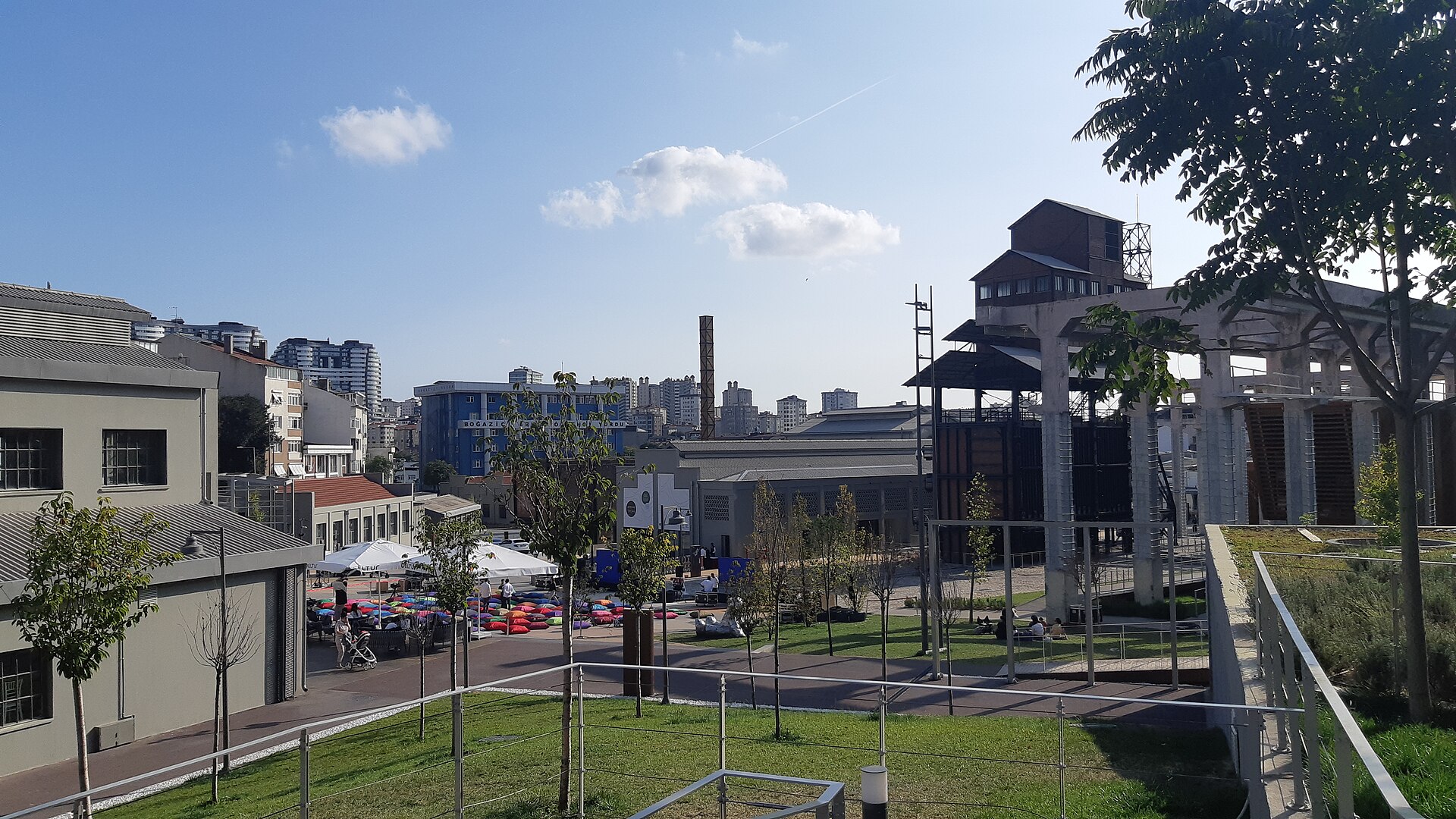
Müze Gazhane, Kadıköy. Photo: Jelican9, Wikimedia Commons, CC BY-SA 4.0
Updated 16 November 2026.
A Saturday morning on the ferry from Kadıköy to Karaköy. Seagulls snatch pieces of simit straight from passengers’ hands, a young waiter weaves between the benches with a tray of tea, and an elderly gentleman by the window is holding a dog-eared magazine and laughing so hard his moustache trembles. The young man beside him, earbuds in, is scrolling his phone and laughing too, at a drawing on Instagram. Look over their shoulders and you will find they are laughing at the same things: rents, the neighbour who parks on the pavement, the eternal Turkish “it’ll work out somehow.” One is laughing at a cartoon in a paper magazine, the other at a drawing an artist in Ankara posted half an hour ago. Between those two smiles lie a hundred and fifty years of history, and it is one of the warmest stories you can tell about Türkiye. Because Turks know how to laugh — at power and at themselves, at hard times and at traffic jams — and they do it with a pencil so brilliantly that the world comes to Istanbul for their cartoon competitions.
Where it all began: Diyojen, 1870
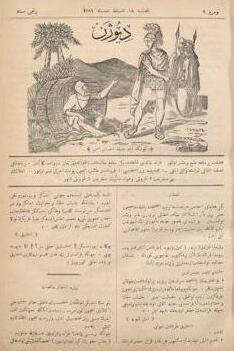
The story of Turkish cartooning begins with a man who seems to have stepped out of an adventure novel. His name was Teodor Kasap, an Ottoman subject of Greek origin born in Kayseri, and on 24 November 1870 he launched the first independent humour magazine in Turkish in Istanbul. He called it Diyojen, after Diogenes, the philosopher who lived in a barrel and wandered with a lantern in broad daylight looking for an honest man. The name proved prophetic: the magazine went looking for the truth and laughed at things nobody was supposed to laugh at. It ran for 183 issues before it was shut down on 10 January 1873. Kasap did not give up and started a new paper, Hayal (“Dream”), but it too was closed in 1877 and its publisher sentenced to three years in prison. So from day one, Turkish cartooning picked up a plot line that runs to this day: laughter and power always walk side by side, always glancing a little sideways at each other.
Other satirical papers such as Çıngıraklı Tatar appeared in the same years, and in 1914 came an event few people know about: the magazine Leylak published drawings by Fatma Zehra, Türkiye’s first known woman cartoonist. Just three issues, but they mark the start of a women’s line in Turkish humour that we will come back to.
The Republic picks up the pencil: Akbaba, Amcabey and Abdülcanbaz
As a new country rose from the ruins of the empire in 1922, it got its own great humour magazine: Akbaba (“The Vulture”). Founded by the writers Yusuf Ziya Ortaç and Orhan Seyfi Orhon, it lived an astonishingly long life, until 1977, becoming a true chronicle of the early Republic. In 1929 the artist Cemal Nadir Güler created Amcabey, “Uncle Sir,” an elderly Istanbul gentleman forever stumbling into absurd situations. It was the first Turkish comic strip, and Cemal Nadir is still called the father of Turkish comics. His drawings — precise, light, full of big-nosed city folk in hats — look remarkably modern even now.
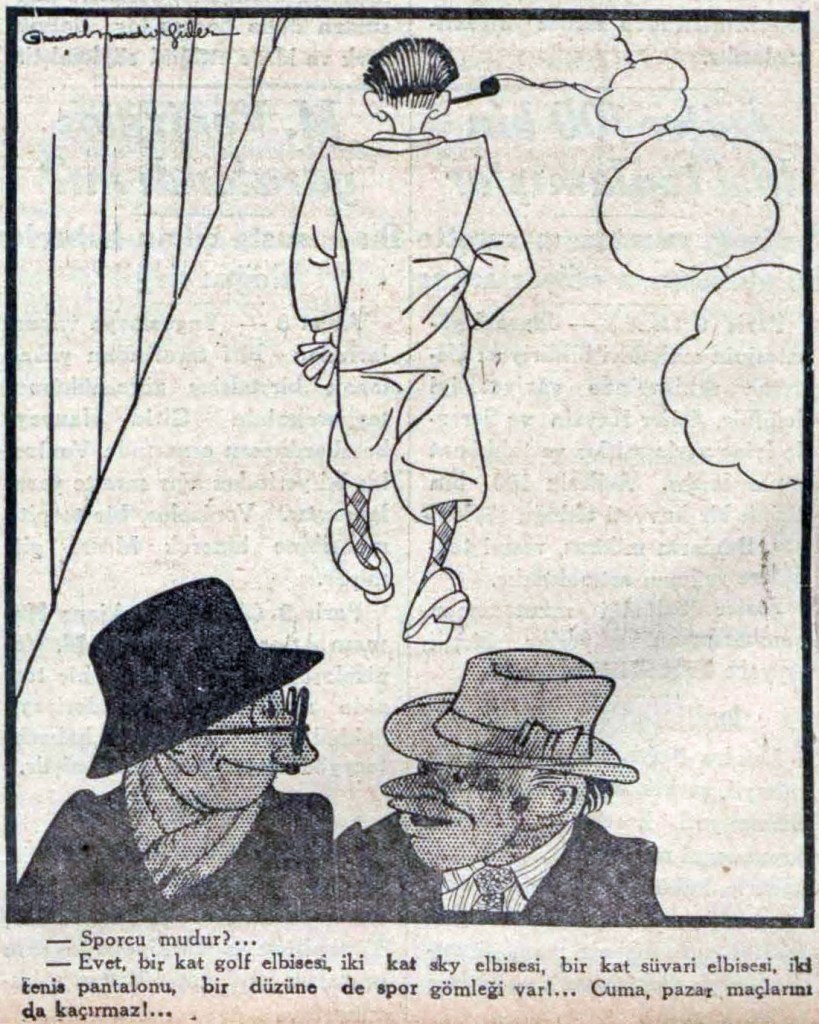
Look at this cartoon from 1935: two townsmen discussing a third who owns outfits for golf, skiing and tennis — and who plays no sport at all, only watches matches. Ninety years on, the joke about the person with expensive kit and a gym membership they never use still lands. That is the secret of Turkish cartooning: it does not laugh at abstractions but at real people everyone recognises in a neighbour, a boss or the mirror.
In 1946 Istanbul saw the launch of Markopaşa, worth mentioning for its contributors alone: the writer Sabahattin Ali, the great satirist Aziz Nesin, and the artists Mim Uykusuz and Haluk Yetiş. It started with a print run of six thousand and reached sixty thousand within months. When it was shut down, it came back under new names, publishing 77 issues in all. In 1957 the newspaper Milliyet introduced Turhan Selçuk’s Abdülcanbaz, a moustachioed strongman and champion of justice who later made it to the stage and the screen. And in 1969 Ferit Öngören, Turhan Selçuk and Semih Balcıoğlu founded the Cartoonists’ Association: a profession born in Diogenes’ barrel finally had a home.
The Gırgır era: when a whole country read one magazine
Ask a Turk over forty what they associate with childhood and many will name not a cartoon show but a magazine: Gırgır. The artist Oğuz Aral founded it in 1972, and what followed was a fairy tale. In its first year Gırgır sold 45,000 copies a week, in the 1970s 300,000, and by the early 1980s around half a million. It was billed as Europe’s third best-selling humour magazine; the cartoonist Tan Oral later admitted that was more marketing flourish than fact, but even without it the numbers are staggering. Gırgır was read on buses and in markets, in barracks and student dorms, passed from hand to hand until its pages were as soft as cloth.
Yet Gırgır’s real miracle was not its circulation. Oğuz Aral built a whole school. The writer Atilla Atalay recalled that the magazine’s writers and artists came from its own readers: a teenager would send in a drawing, the editors would spot a spark, and a couple of years later he was drawing covers. This “Gırgır school” gave birth to Hıbır, Mikrop, Limon and LeMan, then to Penguen (2002–2017) with Erdil Yaşaroğlu, Selçuk Erdem, Bahadır Baruter and Metin Üstündağ, and to Uykusuz (“Sleepless”), founded in 2007 by artists who left Penguen — Yiğit Özgür, Ersin Karabulut, Umut Sarıkaya and friends. Uykusuz still has an “Inbox” page for drawings from beginners, the same reader-to-artist tradition. In 2011 the family welcomed Bayan Yanı, introduced as the world’s first women’s humour magazine. And the sheer scale of this treasure was documented in 2026 in an 860-page book by Engin Kamarot, which records 1,102 humour magazines and newspapers published in Türkiye between 1923 and 2025. Eleven hundred magazines of laughter: try finding another country like that.
Why paper magazines became rare
Then the world changed, as it did for all print media. From the 1990s comedy shows on private TV channels drew readers away, and then came the internet. Uykusuz artist Emrah Ablak explained that the distributor took around forty per cent of sales, while paper was bought from China and Ukraine in dollars, so every jump in the exchange rate hit the magazine directly. In 2018 LeMan shrank its page size because of paper prices, and finding a humour magazine outside Istanbul, Ankara and İzmir became hard. The cartoonist Kenan Yarar summed up something close to a law of nature: a humour magazine lives about ten years, peaks in its fifth, and then circulation declines. Interestingly, turbulent times can briefly bend the curve: in 2013 Penguen’s sales jumped above fifty thousand, because people wanted to laugh at what was worrying them.
In 2017 two legends closed one after the other: Gırgır stopped in February and Penguen’s last issue came out on 18 May. Uykusuz stopped weekly publication on 25 January 2023 and, to its fans’ delight, came back as a monthly; 2026 issues went up from 150 to 180 lira. LeMan moved to fortnightly in 2024. But paper did not die — it became special. Naber, a comic periodical drawn entirely by Umut Sarıkaya, comes out rarely and sells like a book, and its 18th issue, “Naber Hayat,” went to number one in Amazon Türkiye’s comics chart, ahead of Batman and manga. The lesson is simple and very modern: fewer issues, a higher price, and loyal readers who keep every one on the shelf.
Laughter and power: an old story
We have already seen that the first Turkish humour publisher went to prison. Turkish cartooning has learned to laugh about that too. Between 1950 and 1960 the celebrated artist Ratip Tahir Burak faced 54 lawsuits over his drawings and was acquitted in 53 of them. In 1982 Gırgır was shut down for a month over a cover. One of LeMan’s founders, Tuncay Akgün, joked that after eighteen years they simply stopped counting the lawsuits against the magazine “so as not to spoil our mood.” Court cases still happen: a case against LeMan over a cartoon considered offensive to religious feelings has been running since summer 2025, with the next hearing postponed to 2 February 2027.
What is most interesting is how the boundaries have shifted. A survey of cartoonists by researcher Kubilay Çelik (50 artists, half women, half men) found that the topic artists are most wary of is not politics but religion — 74 per cent against 12. Two thirds admit they “sometimes” censor themselves. And still they keep drawing, with the same blend of courage and self-irony that lived in Diogenes’ barrel.
How a cartoonist lives today
Being a cartoonist in Türkiye is a labour of love, not a path to riches. According to the same study, 78 per cent of artists worry about money, more than half work freelance, and only six per cent are on the staff of a publication. Serkan Yılmaz, known to Penguen readers for his “Dudullu Postası” column, took up house painting during the pandemic to pay off debts and said frankly that cartooning is hard to live on these days. But Turkish artists know what the best entrepreneurs know: how to find new paths.
Yılmaz Aslantürk publishes his character Otisabi on Patreon, supported by readers in Kazakhstan, the US, Brazil and Japan. On Instagram, Eda Sayın has 578,000 followers, Can Bilgin (@aylakanimasyon) 330,000, Emrah Ablak 293,000 and Nuri Çetin 284,000; Nuri, incidentally, illustrates the stories of popular stand-up comedians, a genre of its own. Erdil Yaşaroğlu moved into contemporary art: he exhibited at Yapı Kredi bomontiada, and his nine-metre bronze sculpture “Street Dog” stood at Contemporary Istanbul. Gürbüz Doğan Ekşioğlu has drawn eight covers for The New Yorker. Others teach workshops, for instance at the Kadıköy Cartoon House, speak at marketing conferences, and sell notebooks, magnets and stickers featuring their characters. A pencil, it turns out, can become a small business.
Cartoons as big business
The most famous story of cartoons and brands working together dates from 2012. For a Samsung Türkiye project, Erdil Yaşaroğlu drew a cartoon of about 10,952 square metres on the ground in Pınarhisar, Kırklareli province, setting a Guinness World Record — and afterwards a forest of four thousand saplings was planted on the site. It is hard to imagine a more Turkish story: start with a joke and end with a forest. Today Yaşaroğlu is invited to marketing summits such as Brand Week Istanbul to talk about how brands and humour can be friends.
There is a smaller but very lively business too: personalised caricatures. A digital portrait from a photo costs roughly 780 to 3,750 lira on online platforms, companies order group caricatures of their teams as gifts, and at trade fairs and corporate events an artist who sketches guests in ten minutes draws a longer queue than the free-coffee stand. But the true industrial heir of the cartoon is animation. According to the BEBKA regional development agency, Türkiye’s animation market is now about one billion dollars, compared with an estimate of around a hundred million in 2017 (methods may differ, but the growth is clear). In 2024 the year’s box-office leader in Türkiye was a domestic animated film, “Rafadan Tayfa Hayrimatör,” with 2.8 million viewers and 307 million lira in takings. Seventeen of the year’s fifty most-watched films were animated, nine of them Turkish, together drawing more than 5.5 million viewers. Much of the credit goes to the children’s channel TRT Çocuk, launched in 2008, and to state support: between 2005 and 2023 the government put 33 million lira into 27 feature animation projects. “Rafadan Tayfa” and “Kral Şakir” are already licensed to the Middle East and Europe, and income from selling animation and games developed in technoparks is exempt from corporate tax. Industry and Technology Minister Mehmet Fatih Kacır has put Türkiye’s creative-industry exports at more than 8.1 billion dollars. Alongside, comics publishers such as Komikşeyler, İthaki and JBC are growing, as are Turkish webtoons like the LOKMA platform, which publishes stories such as that of a family trying to settle into life in Türkiye.
Where to see Turkish cartoons for yourself
Istanbul’s Caricature and Humour Museum has a life story worthy of a Turkish TV drama. It opened on 2 July 1975, was closed after the 1980 coup, reopened in 1989 in the old Gazanfer Ağa Madrasa in Fatih — with eight thousand original cartoons and some fifteen thousand visitors a year — closed again in 1994 and reopened under public pressure, then closed for restoration in 2010. Today it has a happy ending: the museum is at Müze Gazhane in Kadıköy, the former Hasanpaşa gasworks, admission is free, and its permanent exhibition has a touching name: “Lines That Keep Their Artists Alive.” Also in Kadıköy, the municipal Cartoon House has hosted exhibitions and workshops since 2016.
Türkiye is also one of the world capitals of cartoon competitions. The Aydın Doğan International Cartoon Competition has run since 1983 and is known as the “Oscars of cartooning,” with an archive of work from 137 countries. The International Nasreddin Hodja Cartoon Competition dates back to 1974: its 45th edition drew 650 artists from 62 countries with 2,050 works, and the theme of the 46th, in 2026, is human rights through the eyes of Nasreddin. AI-generated work is not accepted — after one prize at the previous competition had to be withdrawn over suspicions of AI. Every year Kadıköy’s Yoğurtçu Park hosts the free Kadıköy Çizgi Festivali, with international stars, a comics auction and corners where artists will draw you in minutes. And in November 2026 the Galeri Işık Teşvikiye opened “I Am Not a Robot,” an exhibition from the Aydın Doğan archive about where human talent ends and the machine begins.
Women with pencils
Remember Fatma Zehra from 1914? Her work was carried on by the artists who appeared in Gırgır in the 1980s under the cheeky collective heading “Biz Bıyıksızlar” (“We, the Moustacheless”): Gülay Batur, Ramize Erer and Meral Onat. On 8 March 2011 Bayan Yanı launched alongside LeMan; according to Gülay Batur, its first print runs were around fifteen thousand copies. Ramize Erer became the first woman cartoonist to publish her own album and in 2017 received the international Creative Courage Award. Today one of the most popular artists on Turkish Instagram is Eda Sayın, with 578,000 followers. Social media seems to have become the door that women cartoonists once had to push hard to open.
Cartoons in everyday life
For Turks, cartoons are not a museum genre but a shared language. Gırgır was already the voice of “making ends meet” and “boredom,” and Uykusuz’s comeback in 2025 opened with a cover about high rents and packaging that keeps shrinking while the price stays the same. Today cartoons live in Instagram and TikTok feeds: artists draw street interviews, scenes from old Yeşilçam films and moments only someone who has been to a Turkish wedding will understand — like when, in the middle of the halay, the DJ announces the number plate of a car blocking the exit and the dance does not stop for a second. Cartoons are woven into the stage as well: Cem Yılmaz, Türkiye’s best-known comedian, gave his first show at the LeMan Kültür club in Beyoğlu, Abdülcanbaz went to the theatre and the cinema, and Otisabi became a TV series in 2013, though its creator remembers the experience with horror.
And as in any big family, they remember their own. On 5 November 2026 Kemal Aratan, known to the whole country for his character Vah Vahap Vah, passed away at 61. The municipality of Silivri named an art gallery after Oğuz Aral, the founder of Gırgır. In Türkiye, cartoonists become part of the memory of a neighbourhood, a city, a whole generation — like old songs everyone knows by heart.
What it means for foreign businesses
If you are entering the Turkish market, cartoonists can be your shortest route to the Turkish consumer’s heart. An artist with an audience of one to six hundred thousand followers speaks to people in their own language, with their jokes and their worries, in a way no translated slogan ever could. Most artists work freelance, so you can deal with them directly. A live caricaturist at your trade-fair stand or a caricature of the whole team as a corporate gift costs little but stays in people’s memories. Bigger players can look at animation and character licensing, co-productions, and sponsorship of the Aydın Doğan and Nasreddin Hodja competitions or the Kadıköy festival, all of which give a brand a cultural weight advertising cannot buy. And the success of Naber and the monthly Uykusuz shows that collectible print editions and translated comics can still find their readers.
But like any good humour, this one has rules. If the artists themselves are most wary of religious topics, a brand has even less business there; depicting political leaders is also best avoided, as such drawings can lead to lawsuits in Türkiye, and sometimes even those who merely shared someone else’s cartoon have to answer for it. The safe and best-loved ground is everyday life: family, traffic, neighbours, work, food. Secure the rights to drawings with a contract, because unauthorised use of their work is artists’ biggest complaint. And one more piece of advice from people who love their craft: do not pass off an AI-generated image as a cartoon. Competitions ban such work, and the artistic community will not forgive it.
Turkish cartoons: a cheat sheet
| Title | Years | Known for |
|---|---|---|
| Diyojen | 1870–1873 | First humour magazine in Turkish |
| Akbaba | 1922–1977 | Chronicle of the early Republic |
| Gırgır | 1972–2017 | Up to 500,000 a week; a school of artists |
| LeMan | since 1991 | “Oldest independent”; the LeMan Kültür club |
| Penguen | 2002–2017 | Voice of the 2000s; 70,000 in 2010 |
| Uykusuz | since 2007 | Now a monthly |
Instead of an epilogue
Teodor Kasap named his magazine after the philosopher who searched for an honest man with a lantern in broad daylight. A hundred and fifty years later, Turkish cartoonists still carry that lantern; it just shines from a smartphone screen now. They laugh at prices and at bosses, at traffic and at themselves; they are shut down and they come back; they move from magazines to Instagram, from Instagram to museums and to covers read around the world. And behind it all is what makes Türkiye impossible not to love: the ability to get through anything as long as you can laugh about it together. So next time you see someone on a ferry laughing over a magazine, take a peek over their shoulder. You might see all of Türkiye there.
FAQ
What was the first humour magazine in Türkiye?
Diyojen, launched by Teodor Kasap in Istanbul on 24 November 1870. It ran for 183 issues.
What are the most famous Turkish humour magazines?
Akbaba, Gırgır, LeMan, Penguen and Uykusuz. In the early 1980s Gırgır sold around 500,000 copies a week.
Where can I see cartoons in Istanbul?
At the Caricature and Humour Museum in Müze Gazhane, Kadıköy (free entry), at the Kadıköy Cartoon House, and at the Kadıköy Çizgi Festivali.
Can a foreign company work with Turkish cartoonists?
Yes: most artists work freelance. Choose everyday themes, avoid religion and politics, and secure the rights to drawings by contract.
Sources
Kubilay Çelik’s study of Turkish cartoonists (DergiPark, 2025); Forbes Türkiye on the animation industry; reporting by BBC Türkçe, DW Türkçe, Journo, Medyascope, Hürriyet, Cumhuriyet and T24; the Turkish Cartoonists’ Association; the Aydın Doğan Foundation; Kadıköy Çizgi Festivali; Engin Kamarot, “Türkiye’nin Mizah Dergi ve Gazeteleri 1923–2025.” Photos: Wikimedia Commons (Jelican9, CC BY-SA 4.0; Diyojen and the Cemal Nadir cartoon are in the public domain).
This article is for information purposes. Circulation and market figures come from public sources and estimates; no audited circulation data for 2024–2026 is available.