


🎧 Listen to the TRBW podcast on this article
⬇ Download audio (m4a, 15 min)
Key points
- The International North–South Transport Corridor (INSTC) returned to full operation in 2026: 8.9 million tonnes of cargo moved along it in January–September, up 9.6% year on year.
- The main driver is instability on sea routes: the Red Sea and the Black Sea, the Suez Canal, and the Bab el-Mandeb and Hormuz straits.
- The Trans-Caspian route grew fastest (+19.3%); the western branch via Azerbaijan rose 9.2% and the eastern branch via Central Asia 8.6%.
- Türkiye is linking the INSTC with the Middle Corridor and the Development Road to become a distribution hub between Asia, the Gulf and Europe.
- Gains for Türkiye: transit and customs fees, port, warehousing, insurance and forwarding revenue, and processing of cargo in Turkish organised industrial zones (OSB).
What is the INSTC and why did it revive in 2026?
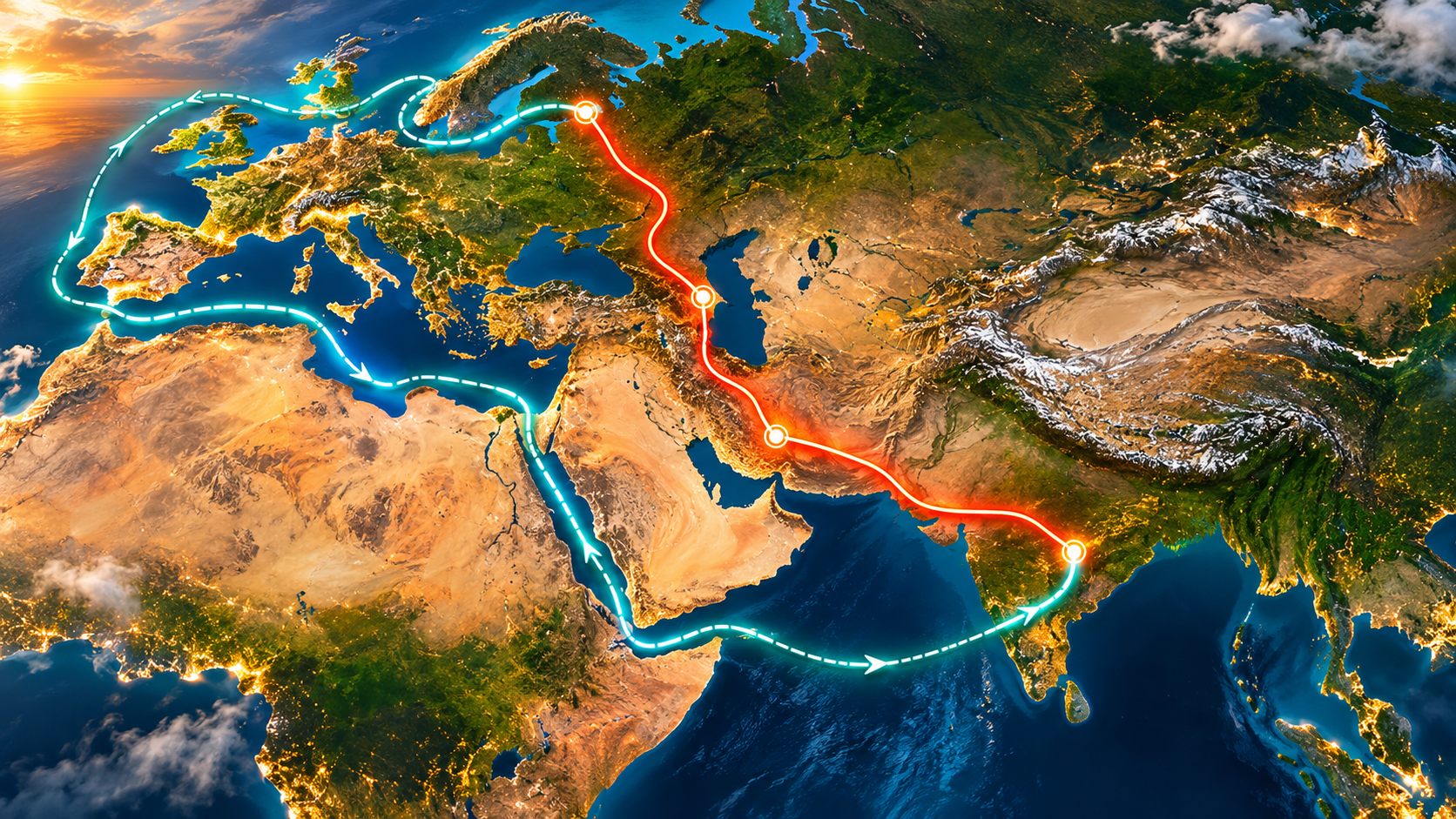
The International North–South Transport Corridor (INSTC) made a full return to operation in 2026. The key driver of this sharp revival was the deteriorating situation on traditional maritime routes. According to Türkiye’s Ministry of Transport and Infrastructure, instability in the Red Sea and the Black Sea and in the Suez Canal, together with risks around the Bab el-Mandeb and Hormuz straits, pushed global players to look for alternative overland routes shielded from military disruption. Running mostly over land, the North–South corridor has become a safe alternative for cargo transit between Russia, Central Asia, Iran and India. A noticeable diplomatic thaw between Moscow and Baku was critical to the corridor’s restart this year. The western branch runs from Russia through Azerbaijan into Iran. The easing of regional tensions in spring made it possible to fully launch rail transit across Azerbaijani territory towards the Persian Gulf ports, despite continuing geopolitical tension around Iran. By October, coordination between Baku, Tehran and New Delhi on this route had grown several times over.How much cargo did the North–South corridor carry in 2026?
In January–September 2026, total cargo traffic on the INSTC reached 8.9 million tonnes, a net increase of 9.6% on the same period of 2025.| Route | How it runs | Growth |
|---|---|---|
| Trans-Caspian (Caspian Sea leg) | Rail and ferry | +19.3% year on year |
| Western | Rail via Azerbaijan | +9.2% |
| Eastern | Rail via Kazakhstan and Turkmenistan to Iran | +8.6% in the first half |
| Whole corridor | January–September 2026 | 8.9 million tonnes, +9.6% |
How Türkiye is plugging its routes into the corridor
For Türkiye, this period has been the starting point for integrating its own routes into global logistics axes. Under the Medium-Term Programme for 2027–2029, Ankara is investing in connecting its eastern rail network (Kars – Iğdır – Dilucu) and the Development Road project (from Iraq to Europe) with the East–West and North–South flows. Türkiye aims to anchor these routes on its own logistics hubs, building a resilient alternative network.Through tariffs, new members and modernisation
By the start of the year, agreements setting uniform through tariffs for shippers along the entire overland section had entered into force. This removed price disputes at the borders and made the route via the Astara border crossing economically predictable. In the first nine months, container volumes at this junction showed steady growth. The project is no longer purely trilateral (Russia – Iran – India). Qatar and Saudi Arabia have officially begun to join the initiative. Agreements under preparation are turning the North–South corridor into a through artery tied to the infrastructure of the whole Arabian Peninsula. Connecting routes towards Pakistan and Afghanistan, linked to the Trans-Afghan Railway, are also being studied. On the technical side, participants focused in 2026 on upgrading rolling stock. With Baltic and Caspian ports congested, INSTC operators switched en masse to small-format containers and specialised containers for bulk cargo (including grain). This removed delays when switching modes (from river or sea to rail) on the Caspian and Azerbaijani sections.What advantages does the INSTC open up for Türkiye?
The revival of the North–South corridor opens up major strategic and commercial advantages for Türkiye. Ankara sees the corridor not as a rival to its own projects but as a key element in turning the country from a transit bridge into a global distribution and production hub. The main advantage lies in linking the INSTC with the east–west Middle Corridor and the north–south Development Road (Kalkınma Yolu). According to Türkiye’s Ministry of Transport, integrating these axes into a single network makes the country the main distribution hub between Asia, the Persian Gulf and Europe. This lets Türkiye not just pass other countries’ cargo through, but manage trade flows at the junction of four regions.What direct financial benefits does Türkiye get?
Connecting the Turkish rail network (via Kars, Iğdır and the line under construction towards the Zangezur corridor) to the INSTC’s western branch through Azerbaijan gives direct access to growing Eurasian freight traffic. Türkiye benefits financially through:- higher customs clearance and transit fees on its territory;
- higher port revenue, in particular for the new deep-water logistics port of İyidere on the Black Sea, designed for this flow;
- income from warehousing, cargo insurance and freight forwarding.