


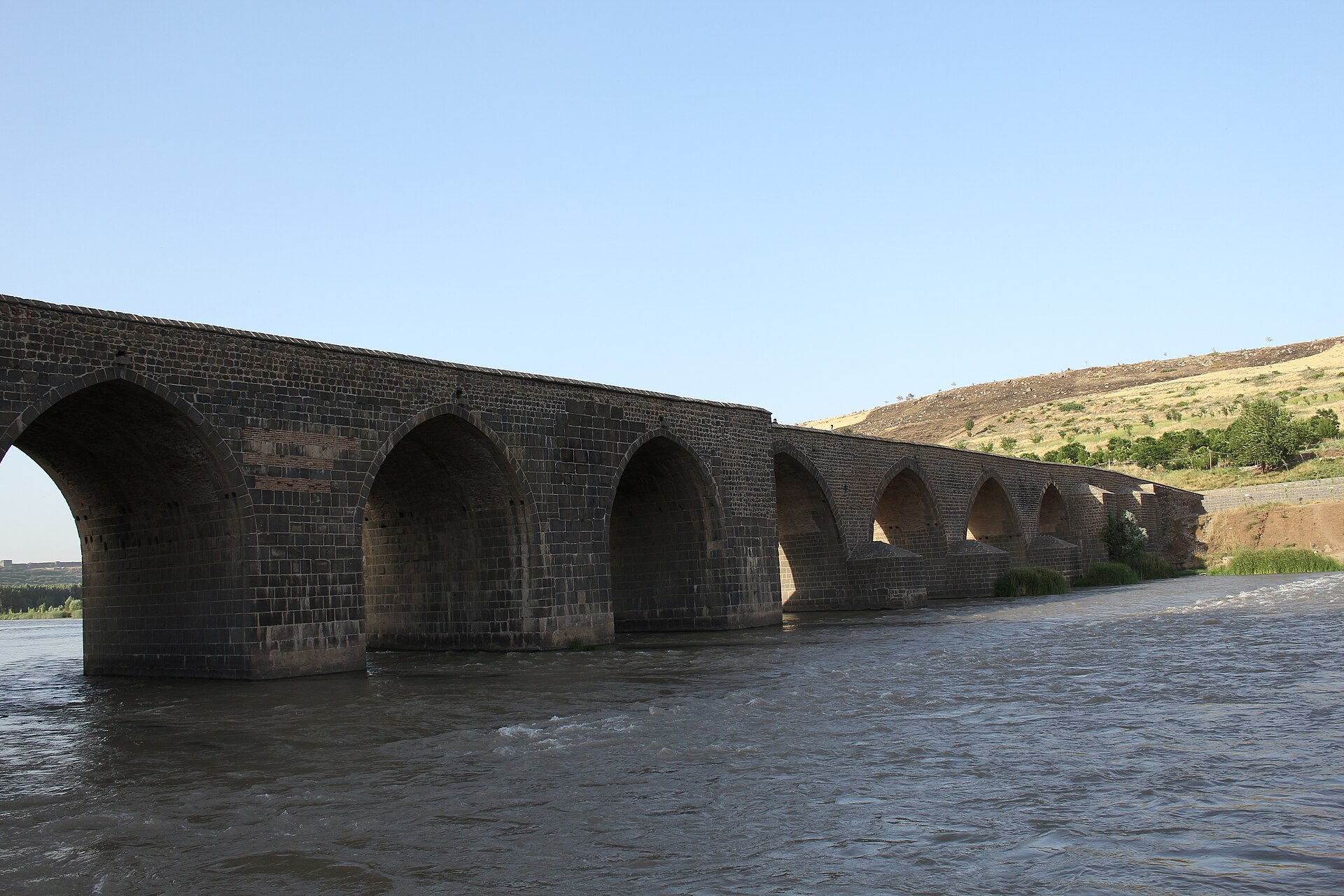
Dicle (On Gözlü) Bridge, Diyarbakır. Photo: Hedda Gabler, Wikimedia Commons, CC BY-SA 4.0
Seven in the morning in the courtyard of Hasan Paşa Hanı in Diyarbakır. The sun is just climbing over the black basalt walls, and waiters are already darting between tables with trays that cannot hold the whole breakfast: dozens of little plates of cheese, honey, kaymak clotted cream, olives, herbs, eggs with sucuk sausage, fresh flatbread — and, of course, tea in tulip-shaped glasses, refilled here before you think to ask. At the next table three students argue about football, an elderly gentleman reads his paper, and a visitor from Istanbul photographs her plate for the twentieth time. A couple of hours later the same city will offer you a very different breakfast-lunch: skewers of liver grilled over charcoal right in front of you. That is when you understand that in Diyarbakır food is not a meal but a way of life. All around are walls more than fifteen centuries old, the Tigris River, along whose banks people have lived since they first learned to settle in one place, and one of the youngest, liveliest and most hospitable cities in Türkiye.
Where Diyarbakır is and why it is so young
Diyarbakır stands in south-eastern Türkiye on a high bank of the Tigris — the Dicle in Turkish — where the river makes a gentle bend and flows on towards Mesopotamia. To the west the city is guarded by the extinct volcano Karacadağ, whose lava gave the black basalt from which everything here was built: walls, mosques, bridges and homes. That is why Diyarbakır has long been called “Kara Amid,” Black Amida. Summers are as hot as real Mesopotamia, winters can bring snow, and in spring the whole Tigris valley turns so green you can hardly believe the steppe is all around.
According to TÜİK, the province had 1,852,356 residents at the end of 2025, and the population keeps growing. It is one of the youngest regions of the country: the median age is 26.7, and young people aged 15–24 make up 17.3% of the population (321,174 people) against a national average of 14.8%, and on evening streets the whole city feels like one big student gathering. There is also a record locals mention with a grin: the Bağcılar neighbourhood in the Bağlar district, with more than 160,000 residents, is the most populous mahalle in Türkiye, larger than entire provinces such as Bayburt or Tunceli. People joke that if it became a province of its own, it would immediately get its own football club, its own kebab dynasty and its own governor.
Walls that have seen everyone
Diyarbakır’s greatest legend is its city walls: a black basalt ribbon about 5.8 kilometres long, 98 of whose more than a hundred towers still stand, with gates through which Assyrians, Romans, Byzantines, Sasanians, Arabs, Artuqids, Aq Qoyunlu and Ottomans all passed. Many call them the world’s second-longest walls after the Great Wall of China; historians love to argue about that, but there is no arguing with the impression. The walls took their present form in the fourth century under the Roman emperor Constantius II, and every era since has left its inscriptions and reliefs of eagles, lions and dragons, as if signing a guest book. In 2015 UNESCO inscribed “Diyarbakır Fortress and Hevsel Gardens Cultural Landscape” on the World Heritage List. The Hevsel Gardens are the green strip between the walls and the Tigris, cultivated for thousands of years, which still send tomatoes, cucumbers and herbs with a special “Hevsel” flavour to the market.
Inside the walls lies the historic Sur district, a maze of narrow streets now undergoing major restoration. Here stands the Great Mosque, Ulu Cami, one of the oldest mosques in Anatolia, built in the late eleventh century under the Seljuk sultan Malik Shah, its courtyard adorned with columns from ancient buildings. Nearby is the Four-Legged Minaret, Dört Ayaklı Minare, which stands on four slender columns; locals insist that if you walk around it seven times while making a wish, it will come true. A little further on is the ancient Church of the Virgin Mary, Meryem Ana, where Syriac Christians still worship in Aramaic, the language spoken in the time of Christ. And in old black-stone houses there are museums dedicated to two famous natives: the poet Cahit Sıtkı Tarancı, whose verses on life and death schoolchildren across Türkiye learn by heart, and the thinker Ziya Gökalp.
The bridge with ten eyes
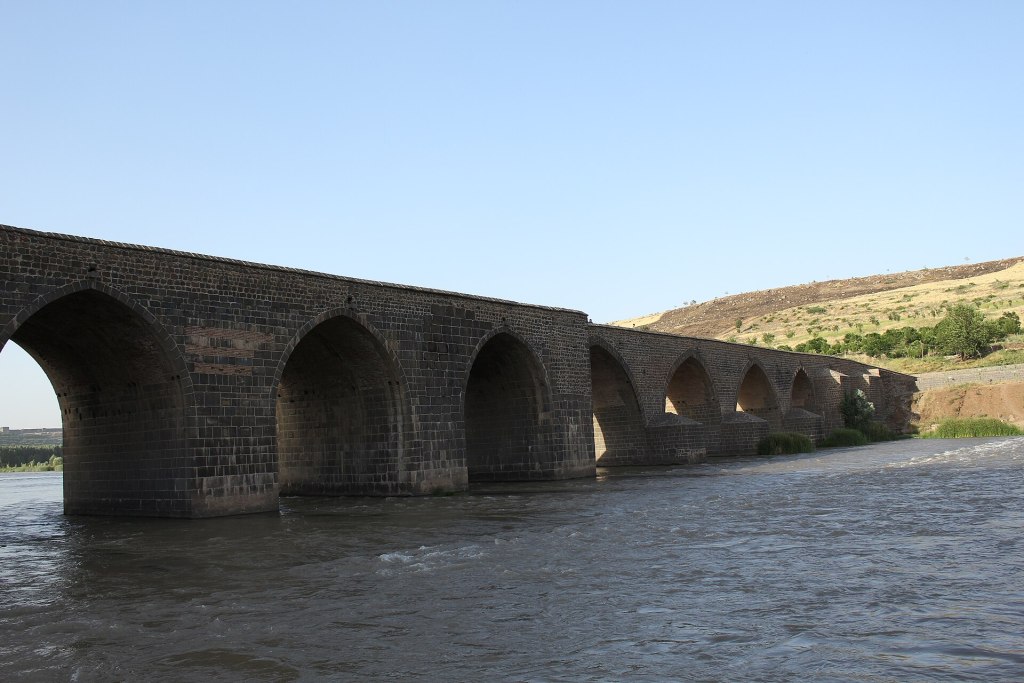
Just below the city a bridge spans the Tigris that locals affectionately call “On Gözlü,” the Ten-Eyed, after its ten arches. It was built in 1065 under the Marwanid dynasty, and for almost a thousand years people have walked it, carts have crossed it, and now couples and families stroll it. At sunset, when the black stone turns warm and the river turns gold, half the city gathers here: drinking tea from flasks, grilling corn, fishing and photographing the same view that never gets old. If you need one picture to remember Diyarbakır by, it will be taken here.
The caravanserai where the whole city has breakfast

Hasan Paşa Hanı was built in the 1570s for merchants travelling the trade routes between Anatolia, Persia and Mesopotamia. Today the merchants are different but the purpose is the same: people meet, strike deals and eat. A courtyard with a domed fountain, galleries of alternating black and white stone, shops full of silver jewellery — and a breakfast people travel from other cities to enjoy. Nearby stands another old caravanserai, Deliller Hanı, now a hotel where you can sleep in a room where caravan travellers slept four hundred years ago.
Diyarbakır is also famous for its crafts. Local masters make delicate silver filigree, “telkari,” and woven “hasır bilezik” bracelets that even have their own geographical indication, along with copperware and basalt carving. In the old quarters you can still hear the dengbêj, folk storytellers who sing long tales of love, journeys and heroes for hours without any instrument. It is one of the region’s oldest oral traditions, and the city has a special house for it where you can simply walk in and listen.
Liver for breakfast and watermelons the size of a child
Ask a Turk what Diyarbakır is famous for and the answer will almost certainly be “ciğer kebabı”: small skewers of lamb’s liver, sometimes with bits of tail fat, grilled over charcoal and served with flatbread, onion, herbs and hot pepper. Locals eat them at any time of day — including breakfast, which never fails to surprise visitors. By some counts the city eats more than five tonnes of lamb’s liver a day. In 2022 “Diyarbakır Ciğer Kebabı” received an official geographical indication, and to celebrate, they say, a tonne of grilled liver was handed out in the square. It was Diyarbakır’s 48th product with such status, putting the province among the country’s leaders in geographical indications. Today Diyarbakır has 59 such products, 55 of them foods and dishes.
The second culinary legend is the watermelon. Diyarbakır watermelon was registered as a geographical indication back in 2008. Locals grow them on the sandy banks of the Tigris, and some are so huge they are carted around in wheelbarrows, while the annual watermelon festival crowns the heaviest one. Add kaburga dolması — lamb ribs stuffed with spiced rice — the tangy stew-soup meftune, local baklava and kadayıf, and fresh vegetables from the Hevsel Gardens, and you will understand why it is hard to leave Diyarbakır without gaining a couple of kilos.
Around the city: from the Neolithic to Mithras
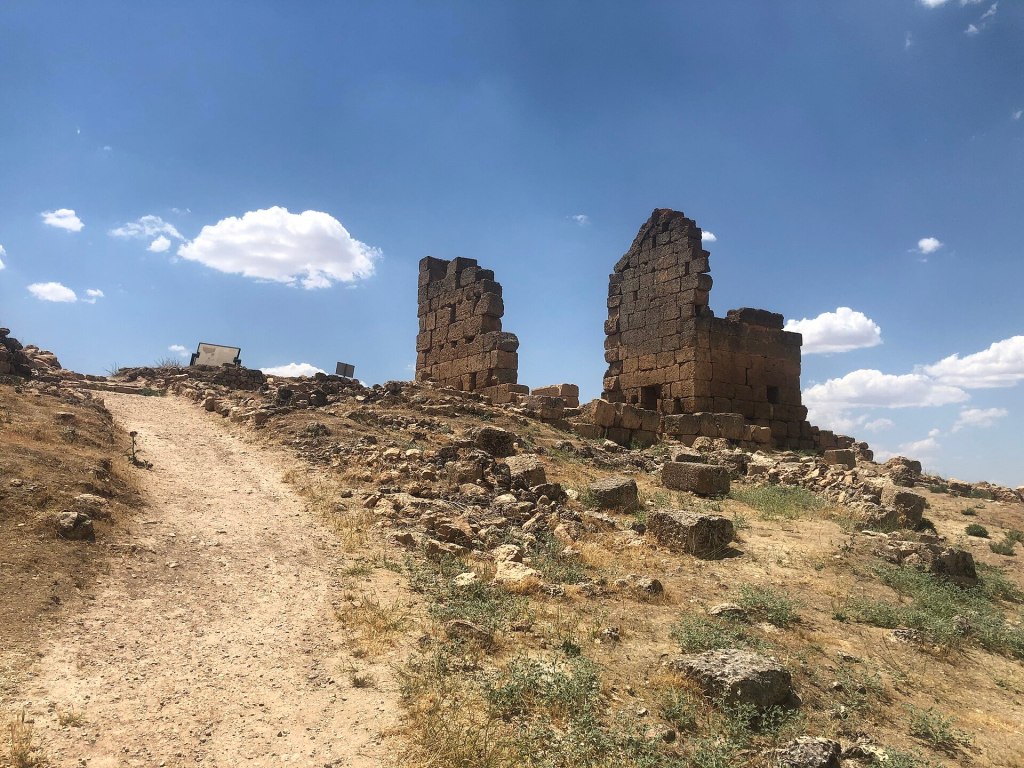
The countryside around Diyarbakır is a real time machine. In the Ergani district lies Çayönü, a Neolithic settlement where people lived some twelve thousand years ago and were among the first in the world to domesticate animals and grow grain. Among the hills near Çınar stand the ruins of Zerzevan Castle, a Roman frontier garrison on the road between Amida and Dara. In 2014 archaeologists found an underground temple of the god Mithras here, one of the best-preserved sanctuaries of that mysterious cult in the East, and Zerzevan has since become one of the most popular weekend trips. Close by are Mardin with its honey-coloured stone houses, Batman, and Şanlıurfa with Göbeklitepe: from Diyarbakır you can see more history in a week than some countries see in their entire existence.
The economy: grain, cotton, marble and the road south
Diyarbakır is the largest city in south-eastern Anatolia and its trading gateway. The local economy rests on agriculture: wheat, cotton, lentils, watermelons and livestock. Around them grow food processing, clothing and textiles, building materials and the famous Diyarbakır marble, quarried in the province and sold worldwide. In the city’s organised industrial zone, according to its management, four phases are more than 95 per cent full, and there is already a queue for a fifth; altogether the province’s four industrial zones employ some 28,000–29,000 people. Provincial exports are rising: according to the Diyarbakır Chamber of Commerce and Industry and the South-Eastern Anatolia Exporters’ Association, they reached 242.8 million dollars in 2024 and 275.6 million in 2025, up 13.5 per cent, with 50.9% of it going to Iraq. Counted by where goods are produced rather than where companies are registered, the province exported 293.8 million dollars in 2025. The main market is neighbouring Iraq, which received more than 120 million dollars of goods in the first ten months of 2025. Local businesspeople believe the real volume is higher, since many goods from Diyarbakır are exported through companies registered in other cities.
Tourism is growing too. According to the governor, Diyarbakır welcomed around 1.6 million visitors in 2025, up from 1.1 million a year earlier, and 847,000 in the first five months of 2026, and the museum complex in the İçkale citadel, which drew 47,000 visitors in 2021, received 194,000 in 2024 and kept growing in 2025. Every year the city hosts the Culture Route Festival, when the streets of Sur become one big stage; in 2025 it even exhibited works by Picasso. The city has Dicle University, an international airport that handled 2.29 million passengers in 2025 and the Karacadağ Development Agency, which supports projects in Diyarbakır and Şanlıurfa, and the province belongs to the sixth and most generous region of Türkiye’s investment incentive system. In 2026 the Local Development Drive programme offers up to 301 million lira in support for four priority manufacturing areas here. The housing market is lively too: 30,036 homes were sold in the province in 2025.
What Diyarbakır means for Türkiye
Diyarbakır is the heart of the south-east, a city that links Anatolia with Mesopotamia and Türkiye with its most ancient history. Here in the Tigris valley civilisation began, empires followed one another, and a mosque, a church and a caravanserai stand on the same street, all part of one shared story. Today it is a young, noisy, ambitious city where students open cafés in black-stone houses, farmers bring watermelons to market, and businesspeople build factories and trade with their neighbours. It has everything that makes Türkiye impossible not to love: deep history, a generous table, warm people, and that special energy that makes you feel the best times are still ahead.
How to talk about Diyarbakır with Turkish partners
If your counterpart is from Diyarbakır, start with food and you cannot go wrong. Ask where the best ciğer kebabı in town is, and you will get not only an address but a fifteen-minute lecture on why the liver must be just so and the charcoal from just that wood. Praise the breakfast at Hasan Paşa Hanı, mention the watermelons, the Ten-Eyed Bridge or the walls: people from Diyarbakır are very proud of their city and delighted when guests know more about it than “somewhere in the south-east.” Hospitality here is legendary: refusing a second helping is nearly impossible, and business meetings often begin with a long tea and questions about family. Do not rush; trust matters more than speed here, and a deal made over a shared table usually holds better than any contract. And, as everywhere in Türkiye, the future, business and food make better topics than politics.
For business, the region is interesting in several directions: agricultural processing and geographical-indication products; textiles and clothing; marble and building materials; logistics and trade with Iraq and the Middle East; and tourism, from boutique hotels in Sur’s old houses to food tours. A young population means both a workforce and a large domestic market. There are challenges too: hot summers, competition for skilled staff, and exports that depend on conditions in neighbouring countries. But generous investment incentives and a growing industrial zone make Diyarbakır one of the most interesting cities for anyone considering manufacturing and trade in the south.
Diyarbakır in numbers
| Indicator | Value | Year |
|---|---|---|
| Provincial population | 1,852,356 | 2025 |
| Bağcılar, Türkiye’s largest neighbourhood | ≈160,000 residents | 2024 |
| Exports | $275.6 million (+13.5%) | 2025 |
| Visitors to the city | ≈1.6 million | 2025 |
| Walls and Hevsel Gardens on UNESCO list | since 2015 | — |
| Geographical-indication products | 59 | 2026 |
| Median age | 26.7 | 2025 |
| Airport passengers | 2.29 million | 2025 |
Instead of an epilogue
Evening on the Ten-Eyed Bridge. The Tigris rushes under the arches, someone on the bank is grilling corn, children run about with balloons, and on the hill above, the walls that have seen everyone and outlived everyone darken against the sky. In the morning the caravanserai will again set out three dozen plates on every table, the shop by Ulu Cami will again be grilling liver, and at the market a seller will assure you that this watermelon is the sweetest in the world. And you know what? He is probably right. Diyarbakır welcomes guests as if it had been waiting for them for a thousand years. Come and you will see why people leave with a heavy suitcase and a light heart.
FAQ
What is Diyarbakır famous for?
Its black basalt city walls and Hevsel Gardens (UNESCO), the Ten-Eyed Bridge over the Tigris, the Great Mosque, Hasan Paşa Hanı, ciğer kebabı liver skewers and giant watermelons.
What can I see near Diyarbakır?
Zerzevan Castle with its underground Mithras temple, the Neolithic site of Çayönü in Ergani, and neighbouring Mardin and Şanlıurfa with Göbeklitepe.
What should I eat in Diyarbakır?
Ciğer kebabı, breakfast at Hasan Paşa Hanı, kaburga dolması, meftune, local kadayıf and, in summer, Diyarbakır watermelon.
Is Diyarbakır interesting for business?
Yes: agriculture, textiles, marble and trade with Iraq are well developed, exports grew to 275.6 million dollars in 2025, and the province enjoys some of the most generous state incentives for investors.
Sources
TÜİK (2025 population); UNESCO (“Diyarbakır Fortress and Hevsel Gardens Cultural Landscape,” 2015); TÜRKPATENT geographical-indication database; Diyarbakır Chamber of Commerce and Industry (DTSO) and South-Eastern Anatolia Exporters’ Association (GAİB); Diyarbakır Organised Industrial Zone; Diyarbakır Governorate; Karacadağ Development Agency; reporting by AA, DHA, NTV, CNN Türk and Rudaw. Photos: Wikimedia Commons (Hedda Gabler, Dosseman, Chansey), CC BY-SA 4.0.
This article is for information purposes. Figures come from public sources as of September 2026.