
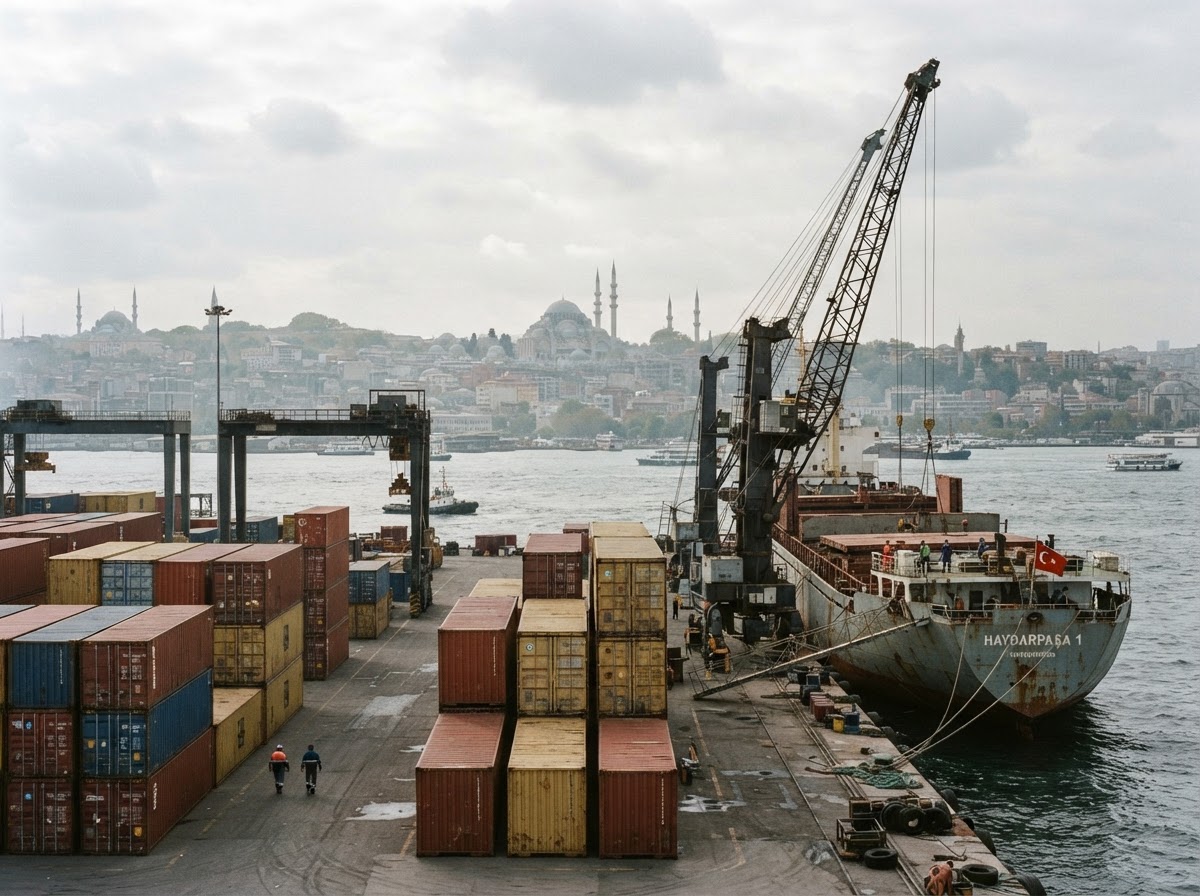


A practical guide for foreign companies importing goods into Türkiye. Prepared on 15 November 2026 from official sources: the Ministry of Trade (Ticaret Bakanlığı), the Revenue Administration (GİB) and the Official Gazette (Resmî Gazete).
Clearing customs in Türkiye is not a single import duty but a chain of payments and procedures: the customs value, the duty set by the GTİP tariff code, the additional customs duty (ilave gümrük vergisi, İGV), sometimes an anti-dumping duty, then import VAT and, for some goods, special consumption tax (ÖTV). This guide explains how Türkiye customs clearance works according to the Ministry of Trade’s official guidance as of 15 November 2026, which documents you need, how long goods may wait, and what changed in the last 30 days.
Key points
- Any individual or legal entity with a Turkish tax number may import (Import Regime Decision, Article 8). Foreign capital is no obstacle, but for customs purposes a company is resident in Türkiye only if it has a registered place of business, registered office or branch there.
- Using a customs broker (gümrük müşaviri) is not mandatory: a company may file declarations itself. In practice most importers appoint a broker by notarised power of attorney.
- After the summary declaration (özet beyan) is lodged, goods must be assigned a customs procedure within 45 days for sea freight and 20 days for other modes of transport.
- Import VAT is charged not on the invoice price but on the customs value plus all duties and charges paid on import.
- In the first nine months of 2026 the Ministry of Trade issued TRY 11.7 billion in additional assessments and penalties after post-clearance checks, 32% more than a year earlier.
Who can import goods into Türkiye?
Short answer: anyone with a Turkish tax number (vergi numarası). The Ministry of Trade’s guidance of 5 June 2026, citing Article 8 of the Import Regime Decision (İthalat Rejimi Kararı), states that imports may be carried out by every individual and legal entity holding a tax number under the Tax Procedure Law, and by partnerships of persons granted legal capacity by law.
That does not mean any company registered abroad can act as importer without conditions. The Customs Law of Türkiye (Law No. 4458, Official Gazette of 4 November 1999, No. 23866, Articles 3 and 5) treats a legal entity as resident in the customs territory if it has a registered place of business, registered office or branch in Türkiye. What matters to customs is therefore not the nationality of the capital but whether the company has a Turkish entity or branch, and who represents it.
If you do not yet have a Turkish tax number, start with our guide Tax Number in Türkiye for Foreigners.
How customs clearance works in Türkiye: seven steps
The sequence below follows the Ministry of Trade’s guidance on commercial imports (5 June 2026). For the final import of commercial goods, a declaration for release for free circulation (serbest dolaşıma giriş beyannamesi) is used and filed electronically.
| Step | What happens |
|---|---|
| 1. Identify the goods | The GTİP code determines duty rates, prohibitions, licences, quotas, the specialised customs office and the conformity and inspection documents required. |
| 2. Pre-arrival notice | Except in specific cases, a summary declaration (özet beyan) is lodged before the goods enter the customs territory. |
| 3. Presentation to customs | The carrier, or the person responsible for transport, presents the goods and links them to the summary declaration. |
| 4. Temporary storage | From presentation until a procedure is assigned, the goods have the status of goods in temporary storage. |
| 5. Procedure declaration | For final import: an electronic declaration for release for free circulation. |
| 6. Licences and checks | Licences and conformity documents required by foreign trade legislation for the product are submitted with the declaration. |
| 7. Payment and release | Trade policy measures are applied, taxes and duties are collected and the goods are released into free circulation. |
How long can goods wait for clearance?
Goods covered by a summary declaration must be assigned a customs-approved treatment within 45 days of the summary declaration for sea freight and within 20 days for other modes of transport. Temporary storage is allowed only at places approved by customs, and it is not the same as a customs warehouse (antrepo).
Storage at facilities run by customs administrations is charged under the 2026 service tariff (published 30 December 2025; amounts in Turkish lira, excluding VAT). For non-export goods the storage charge rises over time: the base rate for the first 20 days, five times the rate for the next 30 days, eight times for the following 30 days and ten times after 80 days. For example, daily storage of a full container costs TRY 125, unloading or loading a full container TRY 1,020 and weighing TRY 305. Private ports and warehouses apply their own tariffs.
Which documents do you need for customs in Türkiye?
There is no single list for all goods: the Ministry of Trade says the documents must be identified from the GTİP code and the measures that apply to it. The main documents and their role:
| Document | Purpose |
|---|---|
| Commercial invoice | Shows the price actually paid or payable, the basis of the customs value. |
| Certificate of origin (menşe şahadetnamesi) | Proves non-preferential origin where measures, İGV or other charges depend on the country of origin. |
| A.TR | Proves free-circulation status under the Türkiye–EU Customs Union. It does not prove origin. |
| EUR.1 | Proves preferential origin under a free trade agreement and gives access to the reduced rate. |
| Transport document | Bill of lading, CMR, waybill; also used to establish quantity. |
| Licences and conformity documents | Surveillance or control document, health certificate, analysis report, technical documents, where the product’s legislation requires them. |
What makes up import duty and taxes in Türkiye?
Customs value: more than the invoice price
The main method is the transaction value: the price actually paid or payable for goods sold for export to Türkiye, adjusted as the law requires (Customs Law, Articles 23–28). The customs value is not limited to the CIF figure on the invoice. If not already included in the price, the following are added:
- transport and insurance to the port or place of entry into Türkiye, and related loading and handling;
- packing and containers;
- commissions and brokerage, except buying commissions;
- an appropriate share of materials and services supplied by the buyer free of charge or at reduced cost for production;
- royalties and licence fees that are a condition of sale;
- any part of resale proceeds that accrues to the seller.
Transport after entry, certain post-import installation and maintenance costs and buying commissions may be excluded if shown separately. Foreign-currency amounts are converted into lira at the Central Bank of the Republic of Türkiye (TCMB) selling rate on the date the customs debt arises. For corporate groups: a relationship between buyer and seller is not in itself a reason to reject the transaction value if it did not influence the price.
Customs duty and the GTİP code
Duty is calculated on the tariff in force when the customs debt arises (Customs Law, Article 15), so the rate depends on the GTİP code and whether a preference applies. The Turkish GTİP code has 12 digits: the first six are the Harmonized System, digits 7–8 the EU Combined Nomenclature, 9–10 the national breakdown and 11–12 the statistical code. Current rates are set in Import Regime Decision No. 3350; the consolidated text on the Ministry of Trade website is dated 25 September 2026.
What is the additional customs duty (İGV), and who is exempt?
The additional customs duty (ilave gümrük vergisi, İGV) is set by Decision No. 3351 (consolidated text dated 25 September 2026), with rates in annexes Ek-1, Ek-2 and Ek-3. The key rules in the decision:
- goods imported with an A.TR but not of EU or Turkish origin pay the “other countries” rate;
- goods originating in a country within the diagonal cumulation system of Türkiye’s free trade agreements pay no İGV if preferential origin is proven;
- no İGV is charged on goods in lists V and VI of the Import Regime Decision;
- the importer is responsible for declaring origin correctly.
So you cannot assume that “everything from the EU” or “everything from an FTA country” is automatically exempt from İGV: the GTİP code, origin, the preferential origin document and the relevant table must be read together.
Anti-dumping duties
Anti-dumping measures are tied to the product, the country of origin and often the individual producer. No consolidated official list of all measures in force by code, country and rate as of 15 November 2026 could be found, so check your GTİP code and country of origin against the specific communiqué (tebliğ) in the Official Gazette.
How is import VAT calculated in Türkiye?
Under Article 21 of VAT Law No. 3065, the VAT base on imports is the sum of:
- the customs value of the goods (if duty is not value-based or the goods are exempt, the CIF value; if that is unknown, the value set by customs);
- all taxes, duties, charges and levies paid on import;
- other costs and payments up to registration of the declaration that are not separately taxed, and price or exchange differences calculated on the price of the goods.
The upshot: VAT is charged on top of the duties, so every additional duty also raises the VAT. The VAT rate depends on the product; there is no single import rate. Some goods also bear special consumption tax (ÖTV, Law No. 4760), calculated by customs on the accepted declaration.
| Charge | Base | Where to check |
|---|---|---|
| Customs duty | Customs value | Decision No. 3350, by GTİP code |
| İGV | Per the decision’s tables | Decision No. 3351, Ek-1 to Ek-3 |
| Anti-dumping duty | CIF value or a fixed amount per unit | Communiqué for the product and country |
| Import VAT | Customs value + all import charges + other costs before registration | Law No. 3065, Article 21 |
| ÖTV | Specific product groups | Law No. 4760 |
Getting the GTİP code right in advance: Binding Tariff Information (BTB)
If the classification is uncertain, you can obtain Binding Tariff Information, Bağlayıcı Tarife Bilgisi (BTB). The legal basis is Customs General Communiqué (Tariff) No. 14, Official Gazette of 3 June 2016, No. 29731.
- Apply electronically or on the form in Annex 1 of the Customs Regulation.
- Issued by the Regional Directorates of Customs and Foreign Trade in Istanbul, Central Anatolia, the Aegean, Uludağ, the Central Mediterranean and Eastern Marmara.
- The application covers the applicant’s and holder’s name and address, tariff nomenclature, detailed description, trade name and supporting attachments; a proposed classification is optional.
- BTB is free of charge; only chemical analysis, expert examination or return of samples is charged.
- Valid for 6 years from issue.
- No official processing time specific to BTB could be found.
Do you need a customs broker in Türkiye?
No. Asked whether working with a customs broker is mandatory, the Ministry of Trade answers “No”. A company may handle customs formalities itself or authorise a customs broker (gümrük müşaviri) by notarised power of attorney. Brokers are private professionals whose services are paid, and they may not charge less than the minimum fees published each year in the Official Gazette. Companies acting for themselves remain subject to the rules on direct and indirect representation and on persons authorised to act.
Inward processing: duty-free inputs for exporters
Manufacturers who export can use the inward processing regime (dahilde işleme rejimi, DİR). Under the suspension system, import duties on inputs are secured by a guarantee that is released once the processed product is exported; under the drawback system, duties are paid on import and refunded after export. An inward processing authorisation is required, and the regime is open to companies resident in the customs territory (excluding free zones). It is not a right to sell imported inputs duty-free on the domestic market. The legal basis is Decision No. 2005/8391 and Communiqué No. 2006/12.
What changed in the last 30 days (16 October – 15 November 2026)
| Date | Document | What it does |
|---|---|---|
| 11.11.2026 | Amendment to Communiqué No. 2025/4 on the prevention of unfair competition in imports, Official Gazette No. 33427, in force on publication | New table of anti-dumping duties on abutments for dental prostheses (GTİP 9021.29.00.00.00) from the Republic of Korea: 15% of CIF value for most named producers, USD 320 per kg gross for two, USD 140 per kg for one and 25% of CIF for all others. |
| 31.10.2026 | Amendment to the Regulation on preferential rules of origin (Pan-Euro-Mediterranean Convention, Joint Committee Decision No. 1/2023), Official Gazette No. 33416, in force on publication | Adds the rules of origin in Article II.5 of the Türkiye–Ukraine Free Trade Agreement to the regulation’s scope. It does not change duty rates. |
| 27.10.2026 | Directorate General of Customs Circular No. 2026/12 on goods used in sea and air transport; repeals Circular No. 2014/17 | Duty exemption procedure for ship and aircraft equipment and supplies and for airlines’ aircraft and engines; declaration exemption codes 97DNZ, BK97A, BK97B, BK972 and 97AKS. Passenger aircraft must have 20 or more seats. |
| 30.10.2026 | Ministry of Trade announcement | In the first nine months of 2026, secondary checks of declarations and post-clearance company audits produced TRY 11.7 billion in additional assessments and penalties, up 32% year on year. |
No general changes to customs duty, İGV, import VAT or ÖTV rates, or to TAREKS, BTB or broker rules, were found in official sources for this period.
Product safety checks: TAREKS
TAREKS is the Ministry of Trade’s electronic, risk-based system for import and export inspections. Physical checks focus on risky products; not every consignment is automatically inspected. The ministry’s page (updated 5 October 2026) lists the 2026 inspection communiqués, including industrial inputs (ÜGD 2026/1), non-road mobile machinery (2026/2), waste (2026/3), chemicals (2026/6), solid fuels (2026/7), consumer products (2026/12) and metal scrap (2026/23). Whether your product is covered depends on the GTİP code and description in the relevant communiqué.
Common importer mistakes
- Treating an A.TR as a certificate of origin. It only proves free-circulation status in the Customs Union; third-country goods with an A.TR pay İGV at the “other countries” rate.
- Using the invoice total as the customs value. Transport to Türkiye, packing, royalties and commissions not in the price are added, and VAT is then charged on the total including duties.
- Missing the 45- and 20-day deadlines. Storage at customs-run facilities becomes five, eight and ten times more expensive after 20, 50 and 80 days.
- Ignoring producer-specific anti-dumping rates. Rates can differ between factories in the same country, as in November’s decision on Korean dental components.
- Getting the GTİP code wrong. Post-clearance checks produced TRY 11.7 billion in assessments and penalties in nine months of 2026; when in doubt, apply for a BTB.
Frequently asked questions
What is the official customs website of Türkiye?
Customs is run by the Ministry of Trade (Ticaret Bakanlığı) through its Directorate General of Customs. Guidance, tariffs and import regime decisions are published on ticaret.gov.tr.
Can a foreign company without a Turkish entity clear goods through customs?
An importer needs a Turkish tax number, and a company counts as resident in the customs territory only with a registered place of business, registered office or branch in Türkiye. Without one, goods are usually cleared by the Turkish buyer or partner.
What is the import duty rate in Türkiye?
There is no single rate: duty depends on the GTİP code and origin (Decision No. 3350), İGV (Decision No. 3351) and anti-dumping duties may be added, followed by VAT and, for some goods, ÖTV.
Are goods from the EU free of all duties?
Not automatically. An A.TR does not prove origin: if the goods were made in a third country, İGV is charged at the “other countries” rate.
How much does Binding Tariff Information cost?
BTB is free and valid for six years; only analysis, expert examination or return of samples is charged.
Source
- Ministry of Trade — FAQ: Imports (05.06.2026)
- Ministry of Trade — Customs Value
- Ministry of Trade — Origin (20.01.2025)
- Import Regime Decision No. 3350 (consolidated)
- İGV Decision No. 3351 (consolidated)
- Customs Law No. 4458
- GİB — VAT Law No. 3065; ÖTV Law No. 4760
- Ministry of Trade — Tariff and BTB
- Ministry of Trade — Customs Brokers
- 2026 Service Tariff (30.12.2025)
- Inward Processing Regime
- TAREKS — product groups under inspection
- Directorate General of Customs circulars 2026 (No. 2026/12)
- Ministry of Trade bulletin, 30.10.2026
- Official Gazette No. 33416 (31.10.2026) and No. 33427 (11.11.2026)
This article is for information only and was prepared on 15 November 2026 from official Turkish sources. Rates for a specific product depend on its GTİP code, country of origin and documents; check the decisions in force and, if needed, a licensed customs broker before shipping.