

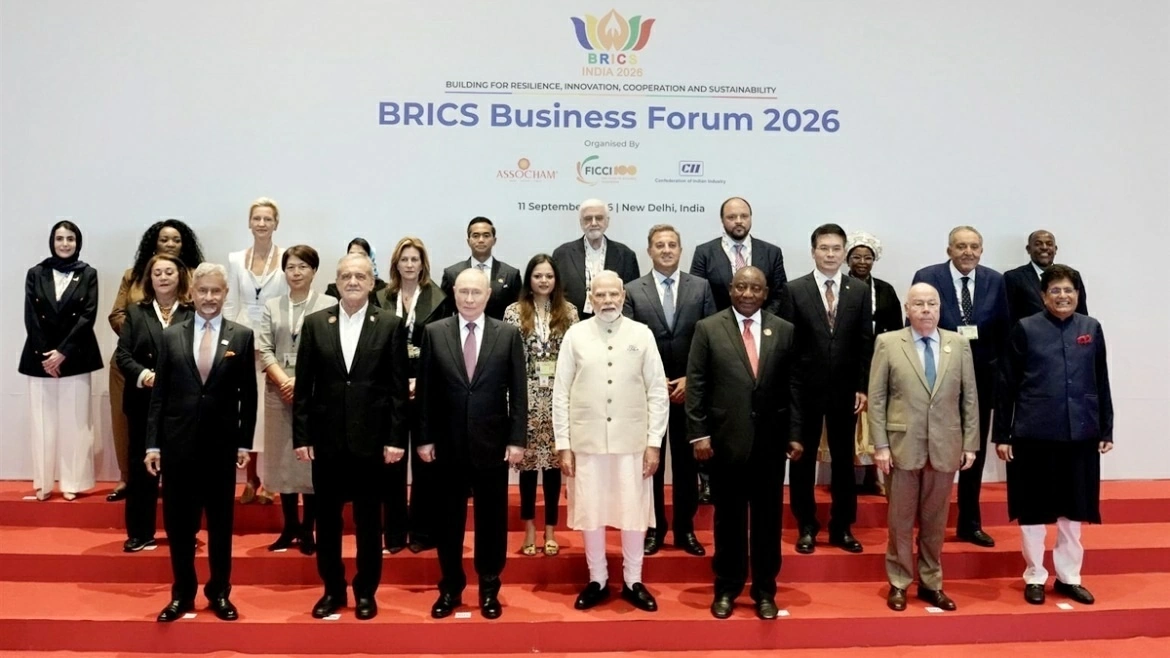
On 12–13 September 2026, India’s capital hosted the 18th BRICS summit. It ended with the adoption of the New Delhi Declaration, which confirmed the members’ commitment to further expanding economic, financial and technological cooperation.
How BRICS has grown
The original BRIC group consisted of:
- Brazil;
- Russia;
- India;
- China.
In 2011 the Republic of South Africa officially joined, and the group became known as BRICS.
In 2024 four new countries became full members:
- Egypt;
- Ethiopia;
- Iran;
- the UAE.
Indonesia joined as a new member in 2025.
The status of BRICS partner country was approved at the 2024 summit in Kazan, Russia, as a mandatory intermediate step before full membership.
As of September 2026, partner status has been formally granted to 10 states that have confirmed their consent and take full part in BRICS events:
- Belarus;
- Bolivia;
- Vietnam;
- Kazakhstan;
- Cuba;
- Malaysia;
- Nigeria;
- Thailand;
- Uganda;
- Uzbekistan.
Türkiye’s application for BRICS membership
In 2024 the Turkish leadership submitted an application for BRICS membership.
Turkish authorities explained the move by the lack of progress in long-running EU accession talks and the wish to strengthen economic ties with the countries of the Global South.
Türkiye at the 18th BRICS summit
At the 18th summit, the Turkish delegation took part in the expanded “BRICS Outreach” sessions.
In this format, Ankara joined multilateral discussions on:
- reform of global governance;
- development of digital infrastructure;
- trade settlements in national currencies.
On the sidelines of the summit, the Turkish delegation also used the platform to hold bilateral diplomatic meetings with the group’s key players.
Türkiye has yet to become a full member, as discussions continue within the bloc on whether simultaneous membership of NATO and BRICS is compatible. However, the New Delhi summit confirmed Ankara’s role as a leading partner state.
Why the BRICS Outreach format matters to Ankara
Türkiye secured the right to help shape the agenda of the expanded BRICS Outreach meetings.
For Turkish diplomacy this is an important lever in relations with the European Union, showing that Ankara has a weighty geopolitical alternative.
Türkiye supported the clause in the final declaration on countering unilateral Western tariffs and sanctions.
Preliminary agreements were reached on expanding the use of:
- the Turkish lira;
- the rouble;
- the yuan
in bilateral settlements, in order to reduce dependence on the dollar in international trade.
The Middle East and Türkiye’s position
The 18th summit took place against the backdrop of a major international crisis, including a protracted armed conflict in the Middle East.
Türkiye expressed solidarity with BRICS calls for “maximum restraint” in the Middle East, which allowed Ankara to strengthen diplomatic consensus with rival states in the region – Iran and the UAE.
The economic weight of BRICS
According to the statistical agencies of BRICS states, the group currently accounts for about:
- 49.5% of the world’s population;
- 40% of global GDP;
- 26% of world trade.
The BRICS New Development Bank
The BRICS New Development Bank (NDB) acts as an alternative source of financing.
Founded in 2014 and headquartered in Shanghai, China, the NDB focuses on protecting the economic interests of the Global South and is seen as a fairer alternative to the Bretton Woods institutions.
Unlike the World Bank, where voting rights are tied to capital contributions – giving the US and the EU an advantage – the NDB applies the principle of sovereign equality: each founding country has exactly one vote, and the bank’s loans are not tied to strict political requirements.
Who is joining the NDB
The NDB operates separately from the BRICS political bloc and is actively admitting new members.
Unlike the BRICS group itself, the NDB is a fully fledged international organisation with its own secretariat and charter.
New members of the bank include:
- Bangladesh;
- Egypt;
- the UAE;
- Uruguay.
At the New Delhi summit, BRICS leaders confirmed their course towards further expanding the bank’s membership, turning it into a global development institution of the Global South.
The Contingent Reserve Arrangement
The NDB works alongside another BRICS institution, the Contingent Reserve Arrangement, which has its own capital of $100 billion.
While the NDB funds long-term development, the Contingent Reserve Arrangement serves as a “safety cushion” similar to the International Monetary Fund (IMF), providing rapid liquidity to member countries in the event of:
- a sharp balance of payments deficit;
- pressure on their national currencies.
What the NDB could offer Türkiye
Access to low-interest NDB loans is one of the main advantages for Türkiye.
The bank finances large-scale:
- infrastructure;
- transport;
- energy projects.
Unlike IMF and World Bank loans, NDB loans are not issued under strict political conditions. Such conditions may include austerity, such as cuts in public spending on socially important areas, or tight monetary policy combined with reforms that are painful for the population, including the removal of subsidies and wage cuts.
The economic situation in Türkiye
Türkiye’s economic cooling programme has led to a decline in output in 11 of 18 industrial sectors.
Türkiye faces a growing trade imbalance: in July 2026 the deficit rose by 14% to $7.37 billion, as imports grew faster (+5.2%) than exports (+2.9%).
Over the first seven months of 2026 the deficit reached $60.5 billion, and on an annual basis almost $97 billion.
Trade deficit, lira and inflation
The structural deficit puts pressure on the Turkish lira and increases external debt, making the economy more vulnerable, including to external geopolitical risks and rising energy prices.
Without reducing import dependence, any progress by the Turkish leadership in fighting inflation – 31.51% year on year as of August 2026 – will be offset by a weaker national currency.
If the current pace continues, the trade deficit could exceed $100 billion by the end of the year, while Ankara continues to finance large-scale infrastructure projects.
Deeper cooperation with BRICS members and institutions could help Türkiye address its trade imbalance without the reforms imposed by the Bretton Woods institutions that are painful for the population.